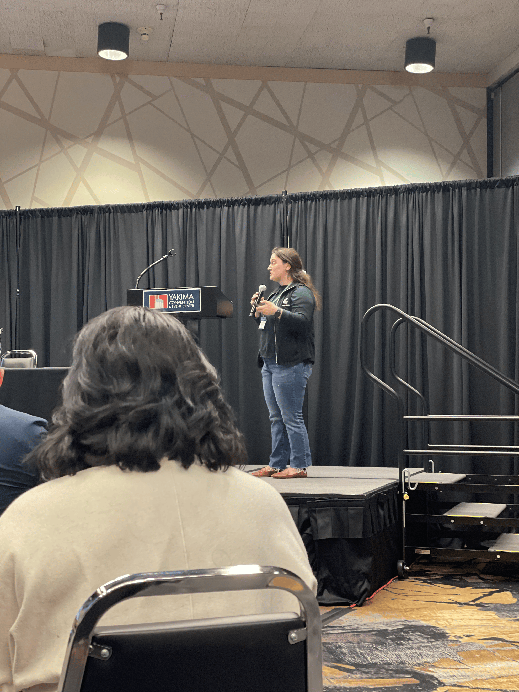
Dr. Claire Murphy is an Assistant Professor and Extension Specialist at the School of Food Science. She is stationed at the WSU Irrigated Agriculture Research and Extension Center in Prosser, WA.
Tell us a bit about your background – professional and/or personal?
I’m Claire Murphy, and I’ve been with Washington State University since August 2023. Time has really flown by! I earned my undergraduate degree in food science at the University of Delaware and then three graduate degrees at Virginia Tech: a master’s in food science and technology, a master’s in public health with a concentration in infectious diseases, and a Ph.D. in food science and technology. While at Virginia Tech, I spent time at a research and extension center, which is where I really developed my passion for research and Extension. Personally, I had twins back in May, so life has been pretty busy! It’s definitely been a big adjustment, but we’re having a lot of fun along the way!
What drove you to pursue Food Science?
I always loved science and knew I wanted a career where I could help protect public health. Growing up in Pittsburgh, my neighbor worked in quality assurance at Kraft Heinz and invited me to shadow him during a shift. That was my first introduction to food science! At the University of Delaware, I started working with a researcher focused on produce safety, and that’s where I really fell in love with the field. What I find so interesting about fresh produce is that we typically don’t have a kill step. Instead, we have to understand where food safety risks exist and how to prevent contamination. I love the challenge of using research to answer those questions and ultimately protect public health.
What are the common issues that you have been seeing in produce packing plants?
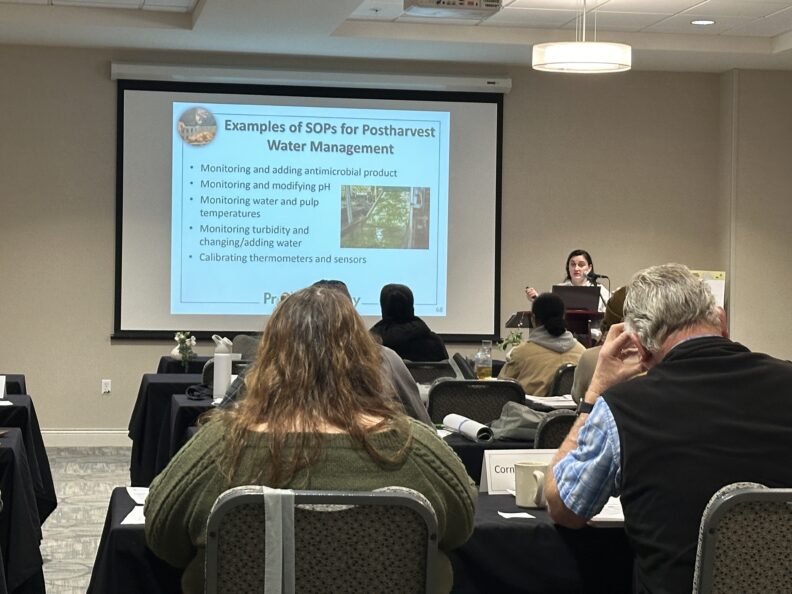
Right now, there’s a lot of interest in postharvest water management, particularly how we prevent cross-contamination while also conserving resources. How long can we reuse water and still maintain food safety? How do we reduce chemical inputs while effectively managing microbial risks? Postharvest handling has the potential for widespread cross-contamination because large volumes of produce often move through shared water systems. With recent guidance on validating water management practices, there’s even more interest in this area. The challenge is finding practical, science-based solutions that balance food safety, water conservation, and the realities of commercial operations.
I have heard of a couple ways to treat produce since heat treatment isn’t viable, so I know of chlorinating the water and using UV-C light as a “kill step”.
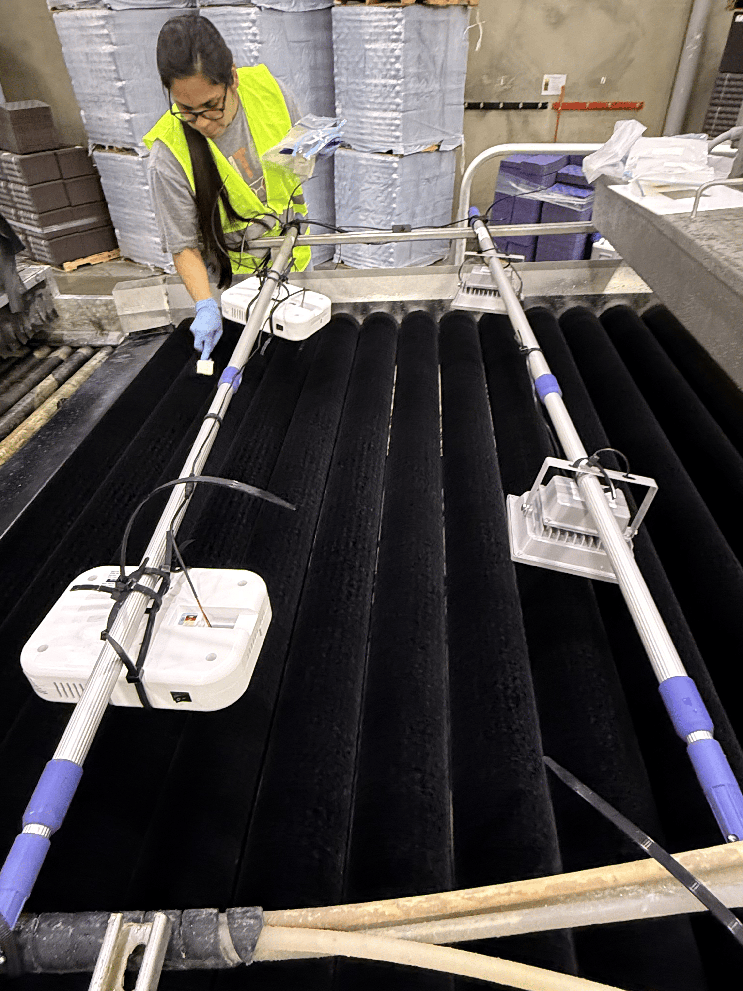
One thing I spend a lot of time emphasizing is that sanitizers in postharvest water are primarily intended to prevent cross-contamination, not eliminate pathogens already on the produce. For example, a contaminated apple could introduce bacteria into a packinghouse water system, potentially spreading that contamination to other apples. Adding sanitizer helps control those bacteria in the water and prevents them from spreading, but it doesn’t necessarily eliminate contamination on the original apple. Chemical sanitizers are widely used, but their effectiveness depends on factors like concentration, pH, and organic matter. We also use multiple preventive measures, or what we call a hurdle approach, so that one failure doesn’t lead to widespread contamination. There’s growing interest in UV-C applications, including on brushes, spray systems, and produce surfaces, but understanding how these technologies perform under commercial conditions is really important.
It’s interesting from a consumer perspective, where foodborne illness was never really a concern of mine when it came to produce until I started learning more about it from working at the School of Food Science.
I think the 2006 E. coli O157 outbreak linked to spinach was a major turning point in bringing attention to produce safety. Before that, many consumers primarily associated foodborne illness with meat and poultry. Since then, we’ve seen numerous produce-associated outbreaks, but I wouldn’t necessarily say that means produce has become less safe. Our ability to detect outbreaks and connect illnesses has improved significantly. Produce also presents unique challenges during outbreak investigations. Supply chains are complicated, and shelf lives are often short. By the time an outbreak is identified, the product may already have been consumed or removed from the market, making it difficult to determine where contamination occurred. That’s why prevention is so important.
After reading through your profile, I noticed part of your work focuses on the development of predictive models in the evolving digital agricultural space. What all plays a part in this?
We have so much data available, whether it’s collected by producers or generated through years of research. We can use that information to develop predictive models and risk assessments to better understand where food safety risks exist. For example, along the apple supply chain, we have research on bacterial transfer from harvest bins to apples, E. coli survival following irrigation, and Listeria contamination on packinghouse equipment. We can bring that information together to identify where contamination risks may be greatest. That’s important because we have limited time, money, and resources, and we want to focus our efforts where they’ll have the greatest impact. One area we’re currently exploring is postharvest water management. We know maintaining an effective sanitizer residual is critical, but what has the greatest influence on maintaining that residual? Is it turbidity, pH, or the microbial load coming in on the produce? Predictive models can help us answer those questions.
Something that’s really important to my program is combining modeling with field research. Laboratory studies are wonderful because we can control individual variables, but commercial operations are much more complicated. What works in the lab doesn’t always work the same way in a packinghouse. By combining laboratory research, real-world data, and predictive modeling, we can develop tools that help the industry make informed food safety decisions.
What’s something you wish more people knew regarding food safety?
I wish more people understood just how much work happens behind the scenes to keep our food supply safe. Through Extension, I work closely with growers and packinghouses, and I see firsthand how committed they are to food safety. When an outbreak or recall makes the news, it’s easy to focus on what went wrong and sometimes place blame on the industry. Of course, we need to understand what happened and make improvements, but I also wish people could see how much effort goes into preventing these events in the first place. A big part of Extension is helping the industry understand the science behind food safety recommendations so they can make informed decisions. The people I work with genuinely care about producing safe food. Nobody wants their product to make someone sick! There are so many people working every day to protect public health, and we’re constantly learning and improving.
There are a lot of layers of challenge with food safety and there are so many ways for food to become unsafe, it could maybe even come down to one person just not washing their hands.
Absolutely! Food safety is incredibly complex, and we’re constantly balancing public health with economic and environmental considerations. Growers and packinghouses need to produce safe food, but their operations also need to remain economically viable. We also want to be good stewards of the environment. For example, we need enough sanitizer in postharvest water to prevent cross-contamination, but we don’t want to use more than necessary, especially when considering water disposal and potential environmental impacts. I think that’s what makes food safety so challenging and interesting. The solutions aren’t always as simple as they might seem.
With so much of your work being in Extension, has there been an experience working with those within the sphere of agriculture that’s been particularly memorable?
One of the most rewarding parts of coming to WSU has been seeing how willing the industry is to collaborate with us. There’s a tremendous amount of trust in WSU, and I really appreciate that. Growers and packinghouses are willing to share their concerns, ask questions, and open their doors to let us conduct research. Of course, that trust goes both ways, and it’s something I’ve spent time building. We’re not just there to collect data or tell people what to do. We’re there to listen, understand their challenges, and work together to find solutions. For me, what’s most memorable is seeing those relationships develop. When someone feels comfortable picking up the phone to ask a question or inviting us into their facility, that really means a lot. Those relationships are what make Extension so rewarding.
I think such an exciting part of Extension is getting to go out and work in the communities that you are conducting research for and directly seeing that impact.
I love Extension! When I decided to pursue academia, I knew I wanted a position with a strong Extension component. One of my favorite things is that Extension directly informs our research. We’re listening to the challenges growers and packinghouses are facing and designing research to help answer their questions. For me, the goal of applied research is to generate information that can be put into practice. We want to finish a project and be able to provide recommendations the industry can actually use. And that’s where Extension comes full circle. The industry helps shape our research, and then it’s our responsibility to get those findings back into their hands through education, technical assistance, and outreach. It’s incredibly rewarding to see our research make a difference in the communities we serve.
I have spoken with a few of your graduate students and I am very excited for what they will get up to after they graduate. I’m curious how it’s like being a mentor for them?
I really enjoy mentoring graduate students! They’re the future of food safety, whether they go into industry, academia, or government. I think it’s important to tailor mentorship to each student’s goals and help prepare them for whatever comes next. We work really hard, and much of our research takes place in commercial packinghouses and out in the field. Just last week, I was at a packinghouse at three in the morning with one of my graduate students! It’s not always easy, but those experiences are incredibly valuable.
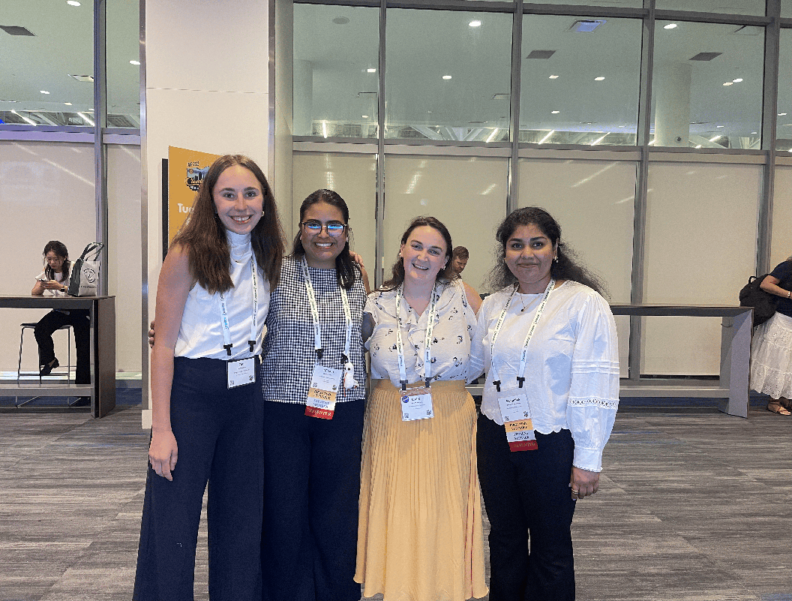
I also want my students to learn how to communicate their research to different audiences. Presenting at a scientific conference is very different from explaining your findings to a grower. We try to provide opportunities for both, along with professional development and food safety certification trainings. Every student is different, and I want them to explore their interests, take ownership of their research, and grow as scientists. One of the most rewarding parts of my job is watching that growth and seeing them move on to the next chapter of their careers.
Any advice for undergraduate or graduate students?
Ask questions, and don’t be afraid to ask to be part of something! Looking back, I learned a tremendous amount in the classroom, but some of my most valuable experiences happened outside of it. Working with growers, participating in Extension activities, and seeing research applied in the real world really shaped my career. I think sometimes I was hesitant to ask for those opportunities, but they helped make me the researcher and educator I am today. My biggest advice is to put yourself out there, even when it feels intimidating. You never know which experience might change the direction of your career. Sometimes, all you have to do is ask!
Any parting words?
Extension is here to help, so please don’t hesitate to reach out! We love answering questions, providing technical assistance, and helping growers and packinghouses work through challenges. At the end of the day, our goal is to protect public health and help ensure our food supply is as safe as possible. One of my favorite things about Extension is that it’s a two-way relationship. I love sharing research and helping the industry, but I also learn so much from them. Every time I visit a facility or talk with a grower, I walk away having learned something new. That’s what makes Extension so special. We’re not just here to share what we know. We’re here to listen, learn, and work together to make a difference.