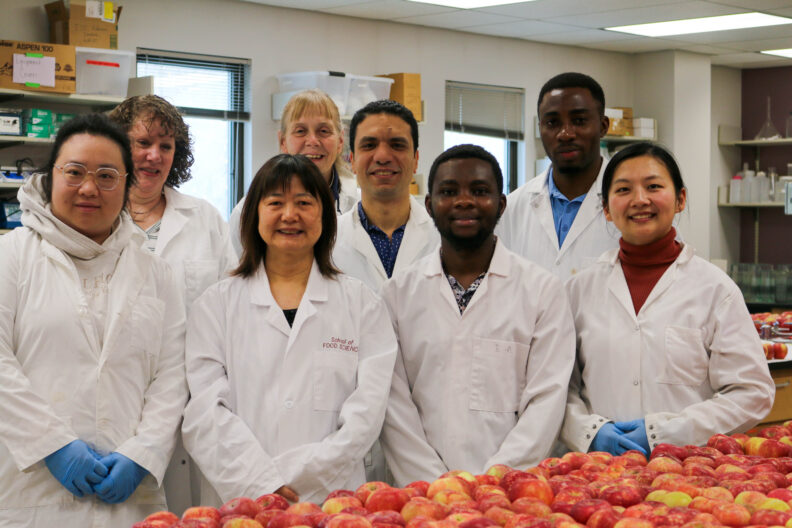
PULLMAN, WA. – Paul Dahunsi is a doctorate student in Dr. Meijun Zhu’s lab, studying food safety and food microbiology.
Tell me about your background, as much professionally or personally that you would like to share.
My name is Paul Dahunsi, and I am from Ijebu-Ode, Ogun State, Nigeria. I began my academic journey studying Animal Health and Production Technology at the Federal College of Animal Health and Production Technology in Nigeria. I later earned a bachelor’s degree in Agriculture, with a focus on Animal Science, from the University of Nigeria, Nsukka. Afterwards, I worked at the International Livestock Research Institute in Ibadan, Nigeria, as a Graduate Research Aide and Swine Project Coordinator, managing swine production and research activities. I also interned at the Bioscience Center of the International Institute of Tropical Agriculture (IITA) in Ibadan, Nigeria, where I was exposed to molecular and biotechnology techniques. I then earned a fully funded MSc in Animal Science, specializing in meat and muscle biology, from the University of Arkansas under the supervision of Dr. Derico Setyabrata. I am now pursuing my PhD in Food Science at Washington State University under the supervision of Dr. Meijun Zhu, focusing on food microbiology and safety.
A defining chapter of my undergraduate journey began with the loss of my father, an experience that reshaped both my responsibilities and the way I approached my future. Determined to ease the financial burden on my widowed mother while meeting my academic needs, I started raising pigs. At the beginning, I had limited resources for feed and would go to restaurants and other places to gather food leftovers for my pigs. As the farm grew, I eventually had more pigs than my wallet could handle. I then diversified into egg distribution as an additional source of income, which helped me sustain the pig operation while also meeting my needs.
As the pig enterprise expanded, I became increasingly aware of how little control I had over the value of what I was producing. Selling live pigs often meant accepting prices largely determined by local butchers, so I decided to move further along the value chain by slaughtering, processing, and selling the pork myself. That decision was eye-opening. I had about a 50% increase in returns, and, even more strikingly, the quality of pork most preferred in the area was the same quality I had been giving away to the butchers through live-pig sales.
At the same time, limited access to refrigerated storage meant that I had to sell the pork on the same day it was processed. That created another form of pressure on pricing, because I had very little flexibility to hold the product and wait for a better market. Preservation and storage therefore became more than technical concepts to me; they were practical limitations that directly affected the value I could retain from what I produced. Together, those experiences gave me a practical understanding of the relationship between quality, processing, preservation, pricing, and economic loss, and ultimately shaped my decision to pursue an MSc in meat science. My MSc. research focused on post-harvest meat storage, including how different shipping factors, different freezer methods, freezer types, and product sizes influenced freezing and meat quality. That training allowed me to study scientifically many of the challenges I had first encountered through experience. Today, I have carried that same interest in post-harvest quality and preservation into my research on fresh produce.
Anything that made you pursue food science specifically?
During my MSc research in meat science, the microbiology and food safety components increasingly stood out to me and pointed me toward a possible career in Food Science. One of my projects involved simulating shipping conditions for frozen meat and identifying factors that could compromise product quality and contribute to economic loss. Through that work, I realized that microbial activity was an integral factor to the quality of frozen meat across several shipping conditions. That made me see food safety and microbiology as the missing piece of the puzzle I wanted to build for my career. I did not know at that point that I would eventually work with fresh produce; but I was sure I wanted my next stage of training to give me a stronger background in food microbiology and safety.
Ultimately, God guided my decision to pursue Food Science. During my undergraduate studies in Animal Science, I was working on my farm one day when God placed the acronym “FST” on my mind, referring to Food Science and Technology, as the discipline is commonly called in Nigeria. At the time, I could not understand the connection or imagine how I could possibly move from Animal Science into Food Science and Technology. I shared the experience with some of my mentors, who encouraged me to pray about it.
Years later, during my MSc, I was already doing research on a food commodity even though I was in an Animal Science program. As my work exposed me more to food quality, microbiology, and safety, I began to see the connection and thought, “This is what God was pointing me toward.” That became even clearer when I later had two PhD opportunities before me: one that would keep me specifically within meat science and another in Food Science. At that point, the earlier FST experience came back strongly. I had the clarity I needed to choose Food Science, and I moved forward with confidence. My current work in fresh produce allows me to strengthen my background in food microbiology and safety while expanding my research experience across food commodities.
Can you describe your current research and what made you interested in pursuing it?
Two sides of food microbiology interest me. One is helping reduce produce losses caused by spoilage organisms, and the other is the broader goal of protecting consumers from foodborne hazards. My current research is focused on the spoilage side, working with postharvest organisms such as Penicillium expansum and Botrytis cinerea. I’m currently evaluating sustainable interventions, including heat treatment, to control these microorganisms on food-contact surfaces. What excites me is the opportunity to work with sustainable interventions that do not leave chemical residues on food or food-contact surfaces, while addressing the broader goal that motivates my work: helping producers reduce losses from spoilage and contributing to safer food for consumers.
With your background in animal science, how does that knowledge affect your research today?
My background in animal science, particularly my training in meat science, has shaped the way I approach research today. It taught me how to develop research questions, translate ideas into experiments, design studies carefully, and interpret results in a way that connects science with practical problems. During my MSc, I was also fortunate to publish two papers, which strengthened my experience with the full research process, from developing a study to communicating the findings. I am especially grateful to my MSc advisor, Dr. Derico Setyabrata, whose mentorship taught me many things that continue to influence how I approach research today.
What has been some of your favorite accomplishments so far during your time here at WSU? I know you’ve received quite a few awards and scholarships in your first year here.
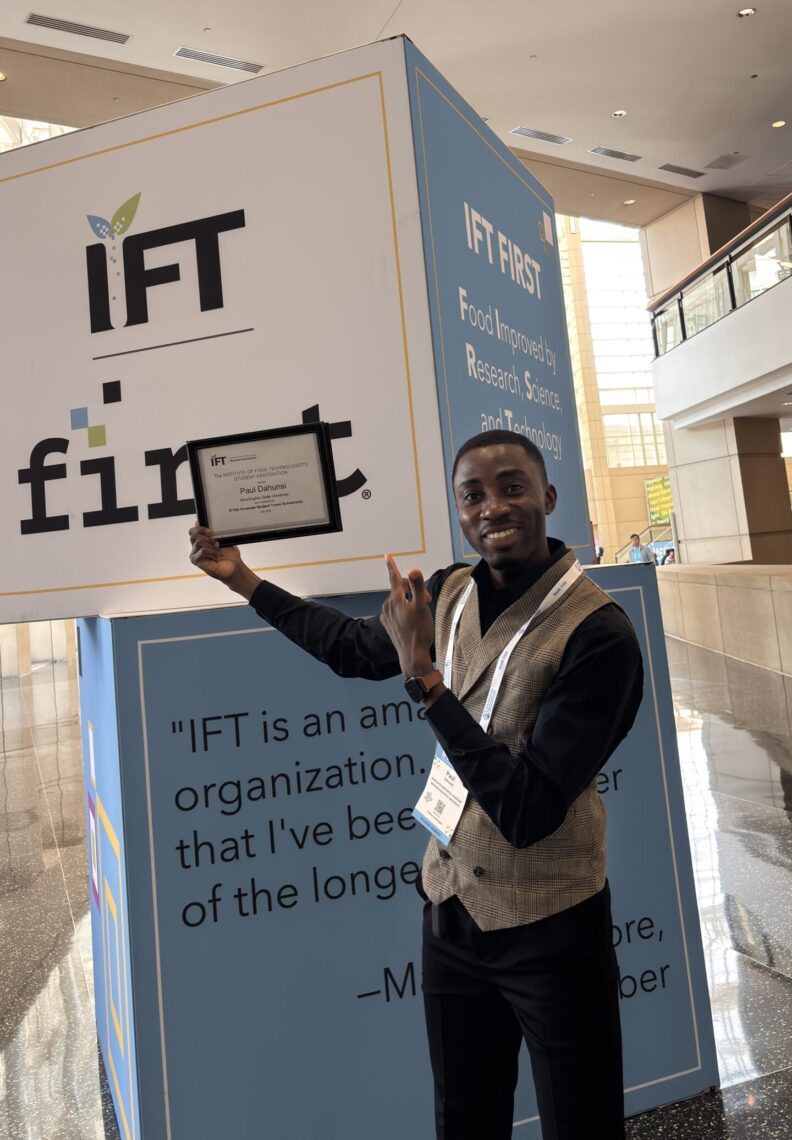
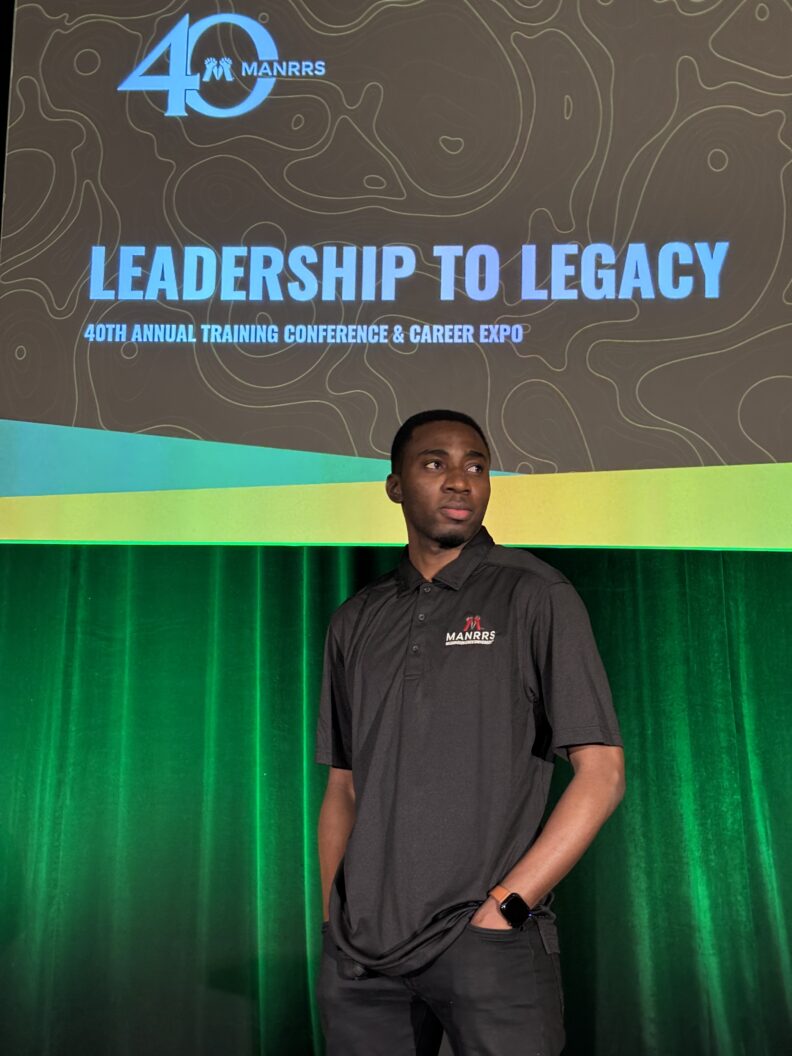
Thank you so much for saying that. I really appreciate it. My first year at WSU has been very rewarding, and I’m grateful to have received several recognitions, including the MANRRS Gold Scholarship, the ASM Future Leaders Mentorship Fellowship, the NASDA Agricultural Policy Summit Fellowship, and the IFT Feeding Tomorrow Fund Travel Scholarship, to name a few. I know my mom, my family, and my advisor, Dr. Meijun Zhu, are proud of me. Above all, I give the glory to God for these accomplishments. There have been moments when I looked at the requirements for an opportunity and wondered whether I should even apply, but I have learned to trust God and put my best foot forward. Seeing some of those applications turn into real opportunities has been very rewarding.
Beyond the awards themselves, I also get a lot of joy from my research. There is something very satisfying about spending days and nights in the lab, working through a project, and eventually seeing the science come together.
One recent accomplishment that stands out to me is receiving the IFT Feeding Tomorrow Fund Travel Scholarship. That one truly felt like a dream come true. I had pursued opportunities to attend IFT FIRST during my MSc, including applying for the scholarship, so receiving it in the first year of my PhD in Food Science meant a lot to me. It reminded me of the value of persistence and made me even more grateful to IFT for investing in my journey as a food scientist.
Attending IFT FIRST in Chicago made the experience even more meaningful. Seeing the wide range of companies, technologies, and professionals represented across the food industry gave me a broader picture of where my training could take me. After spending so much time focused on research, being in that environment reminded me that there is a place for my skills and experiences in the industry. I left with the thought, “I am needed in this industry.”
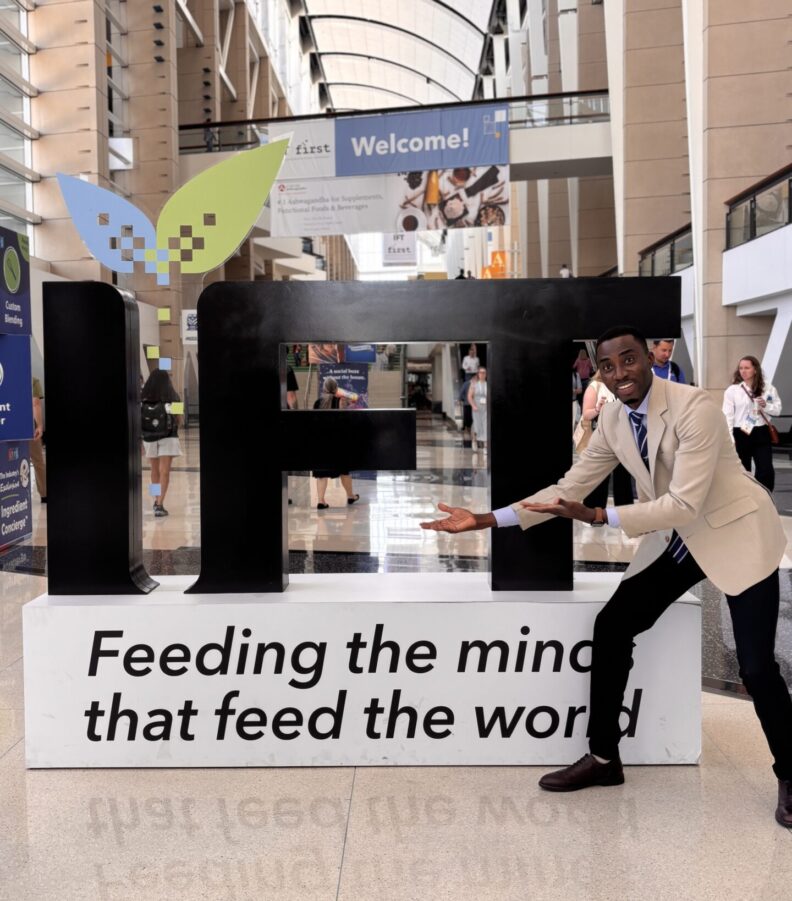
I also want my relationship with IFT and the broader food industry to go beyond receiving a scholarship. Being supported by the organization makes me want to contribute as well, especially through volunteering and service within IFT.
What’s something you wish more people knew about food safety?
One thing I wish more people understood is that you cannot always tell whether a food is compromised by these bugs just by looking at it. Harmful microorganisms may be present even when the food looks, smells, and tastes normal. That is why things like proper temperature control, storage, handling, and cooking are so important.
Food also passes through many stages before it reaches the consumer, from the farm to transportation, retail storage, and finally the home. Thankfully, there are regulations and food safety systems in place to protect consumers throughout that chain, but consumers also have an important role to play. Simple practices such as keeping foods at appropriate temperatures, preventing cross-contamination, and cooking foods to recommended internal temperatures can add another layer of protection for themselves and their families.
What are you hoping to do after you graduate?
With my broad background, I see myself fitting into several areas, particularly the food industry and academia. I’m especially interested in opportunities where I can apply my experience across different food commodities, from fresh produce to animal products. Consulting is one path that interests me because it would allow me to merge different parts of my training and help companies solve practical problems in food quality, safety, and preservation.
Any advice for undergraduate students interested in pursuing a graduate degree?
For me, I knew I wanted to go beyond a bachelor’s degree because many of the positions I was interested in required advanced training. So, if I were an undergraduate considering graduate school, one of the first questions I would ask myself is, “Where do I see myself in the next ten years?” It is perfectly fine to pursue a path that gives you joy and fulfillment, whether that means stopping at a bachelor’s degree, pursuing a master’s, or going on to a PhD. The important thing is to make that decision intentionally rather than feeling like you have to keep going simply because that is what comes next.
As a highly optimistic person who always wants to give my best, I avoid describing graduate school simply as “hard.” It can certainly be challenging, and there may be moments when you ask yourself, “Why am I doing this?” That is why having a strong motive matters. If your motivation is clear, it can help carry you through those difficult moments. So my advice would be to understand what you want from graduate school, make sure it aligns with where you want to go, and then commit to it wholeheartedly.
Any parting words?
Thank you so much for the interview and for putting my thoughts out there. I’m grateful to God for the many accomplishments He has helped me achieve, and I’m grateful to the School of Food Science at Washington State University for giving me an environment to grow and thrive.
I’ll also use this opportunity to invite people out there who are looking for a graduate school to consider WSU and see if the opportunities here fit their goals. We need more people in the food space and the food industry.
If there is something you really want to do and you’re really passionate about, just do it, because if you don’t do it, no one else will. The future depends on what you do now or what you choose not to do. So, I would simply say, do what you have to do now, while you can