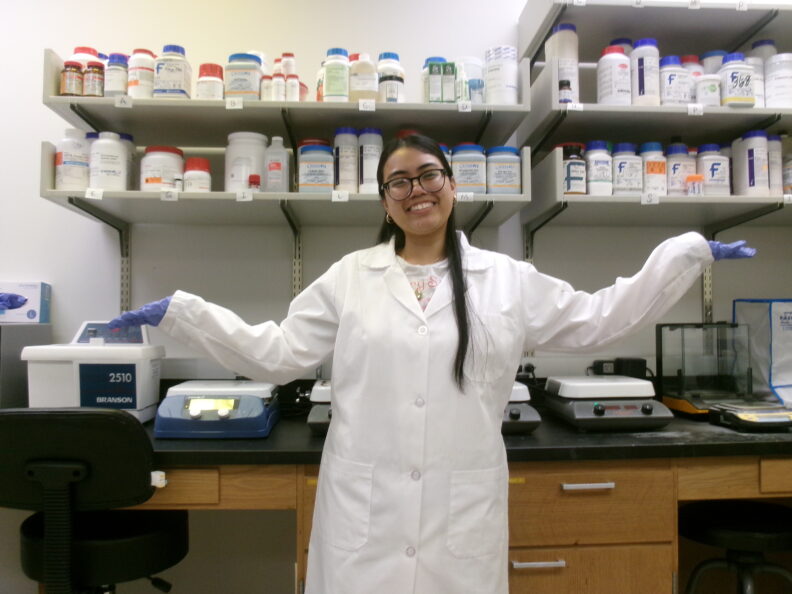
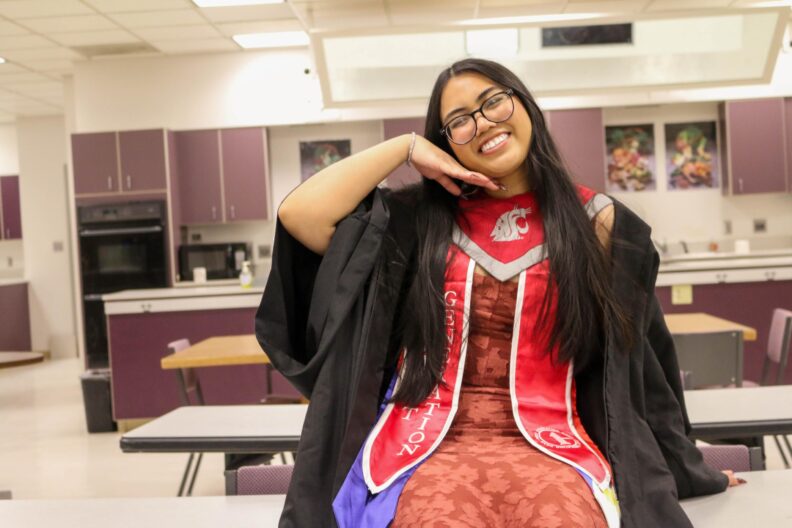
Sherine Ortiz is an undergraduate student studying Food Science and is graduating this May.
Tell us a bit about your background – professional and/or personal?
I am from the beautiful island of American Samoa, and I just got to Pullman, Washington around four years ago and I have made some amazing, unforgettable memories here. In my free time, I enjoy playing the ukelele, reading, as well as hanging out with my friends! I am involved in a couple of things this semester to keep myself a little busy. I am a CAHNRS Ambassador, as well as working as a lab technical assistant, and I have been for a couple of years now. I’ve worked on a couple of research projects, my first one was assisting a PhD student with his fresh rice noodles project, and now I’m working on a personal project with UV-C water bottles and their efficacy in reducing pathogens.
What drove you to pursue Food Science?
I didn’t find out about food science until my senior year in high school. I’ve always been a food lover growing up, and I would always accompany my grandma in the kitchen, either by helping her prep or just watching her cook. Sometimes she wouldn’t follow a specific recipe, so she was always experimenting, which I loved because I always got to be the taste tester. However, even with my love for food, I noticed that it’s always either culinary or nutrition, and I didn’t think those careers were perfect for me.
But a conversation with my mom, who’s a nurse at the only food industry company we have at home, Starkist, changed that. I remember talking to her about what I wanted to do after high school and she reminded me of the field trip we took to Starkist in middle school. I remember one of the research and development managers was giving us a tour of the place and they mentioned food science, that was the first time I have ever heard about it. After that conversation with my mom, that’s when I did more research and thought it was perfect as it combined my love for food and STEM subjects. I started looking for universities that taught it, and it was either here or OSU, and I decided to go to WSU because of scholarship opportunities. Since then, I have never regretted any of the decisions I have made, I just wish I found out about Food Science earlier.
There are a lot of fields within Food Science, which is your favorite?
I am a little biased because I work in a food safety laboratory right now. But I think within all the fields that food science has, food safety is my favorite due to its unpredictability from both industrial and environmental factors. Because you’ll never know where bacteria can be and sometimes it’s in the weirdest spots. That’s where I think it’s fun because I get to investigate, intervene, and help make a safer product for consumers, because we all eat, and we all deserve to eat safe food that doesn’t make us sick!
However, disregarding the bias, I think another great aspect of food science is sensory science because of the interactions you get to have with people and all the different foods that you get to test on. Sensory science is also broad too, because you don’t have to just stick with food. I’ve learned from Dr. Ross that some food science students go into cosmetology, pet food industry, or pharmaceuticals.
How do you feel like your undergraduate research has impacted your education?
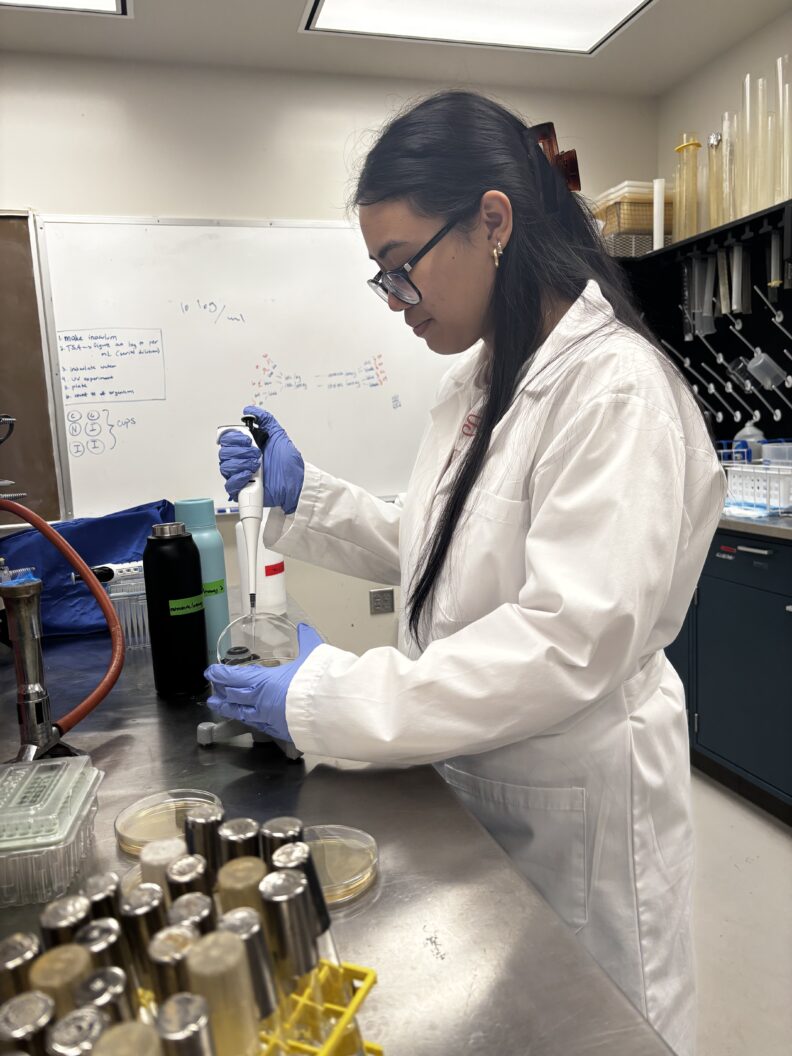
My experience working in a lab has prepared me well for university. It has taught me how important it is to stay organized with data, work efficiently, and manage deadlines. It has also strengthened my ability to work in a team, since lab work often requires coordinating closely with a partner. Additionally, my lab experience has helped me adapt to different learning environments. In class, each professor has a different teaching style, so I’ve learned how to take effective notes and organize them well. In labs specifically, where sessions are usually only two to three hours long , I’ve learned how to use time efficiently and make sure tasks are completed accurately.
My hands on experience in the lab has also given me familiarity with laboratory equipment and procedures. For example, in my food microbiology course last semester, I was already comfortable using basic lab equipment and preparing media and plates. I also had prior exposure to working with bacteria such as Listeria, Salmonella, and E. coli, which helped me better understand the concepts being taught in class and lab.
Would you recommend other students commit to research during their undergrad?
Yes, definitely. Not only does it look great on your resume, because it implies that you have had prior experience on what certain machines do and how to handle specific procedures. But it also helps spark curiosity in food science, because in every class you are going to learn bits and pieces of food science, but you won’t be able to really practice that knowledge unless you’re personally handling something. With all of our different labs, each professor can give you a snippet of something you might want to do, especially because food science is so broad. If you do lab work and get some experience, it can help narrow down your career choices and gain those real life experiences.
Also, it’s super flexible compared to other on campus jobs, since they have a lot of people’s schedules to think about as well. Here, since it’s mostly research, you usually can make your own schedule, and as long as you meet the deadline and have everything done, the professor won’t be so tough on you about it. It also helps you critically think and problem solve because when you’re in the lab, anything could go wrong, but you can figure it out and see how and why it went wrong.
Another reason why I recommend research during undergrad is because of this one quote. One of the PhD students here in Food Science said, “If you’re going to mess up, it’s good to mess up while you’re still in college, because that is what college is for: to learn.” Due to all those trials and errors you learn from undergrad, you learn how to not mess up because if you mess up while working in the industry, it’s going to cost you a lot. Here, you can take it a bit easier, and you can learn from your mistakes and move on.
What has been your favorite accomplishment of yours during your time here at WSU?
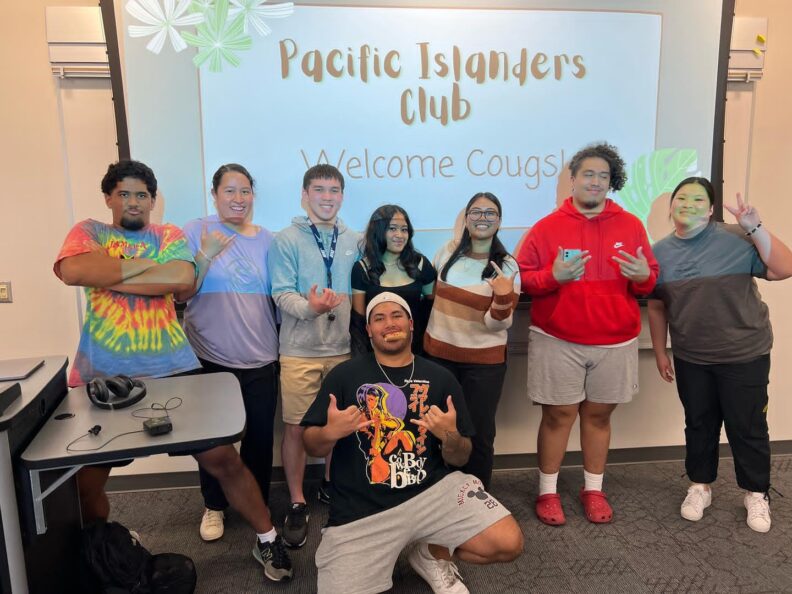
My favorite accomplishment, here at WSU, is actually starting up the Pacific Islanders club again. When I first got here, I went by myself, my family couldn’t come and drop me off like everyone else. Due to that, I was a little nervous coming in, as one usually feels as a freshman. Campus felt so big and I felt like I needed a community to help ground and support me, since being somewhere I’ve never been was scary. So, in my sophomore year, I decided I needed to make a change, so I pushed myself to run for vice president of the Pacific Islanders club. That was the opportunity for me to meet people who have similar backgrounds to me and similar cultures that I’m used to.
Fortunately, I became vice president and throughout that year I learned how to juggle a lot of things, since it was a big job. We also ran a huge event called the Cultural Exhibition and we performed all kinds of cultural dances from the Pacific Islands, so Polynesian, Micronesian, and Melanesian. I truly felt like I found the community and people I was meant to find. That is why this is my favorite accomplishment, because not only did I push myself to be out there, but it also resulted in a great outcome. I never would have known that all these possibilities and opportunities existed if I hadn’t pushed myself.
Is there something you wish more people knew about Food Science?
Food science is very versatile. When you go into food science, people think it’s only about food, but it can be so much more than that. I think that’s the best part about it because you learn so many different things like biology, chemistry, and statistics. You can go into anything as long as you have the knowledge. I’ve known some classmates and friends that have complained that they felt stuck in their major because that’s going to be their job for the rest of their life, which can be really intimidating. But I never felt like that with food science because there are just so many different career options. For example, if one day I end up liking sensory over microbiology, I can always pursue that since I’ve taken classes and labs on it.
Within food science, there are also so many connections. If you ever want to change companies, you will probably find someone who can help you and transition into it. You can literally go into anything since food science is so broad. Additionally, everyone in the world eats, so you will never have to worry about a lack of career or choices.
Any advice for high school students interested in pursuing Food Science?
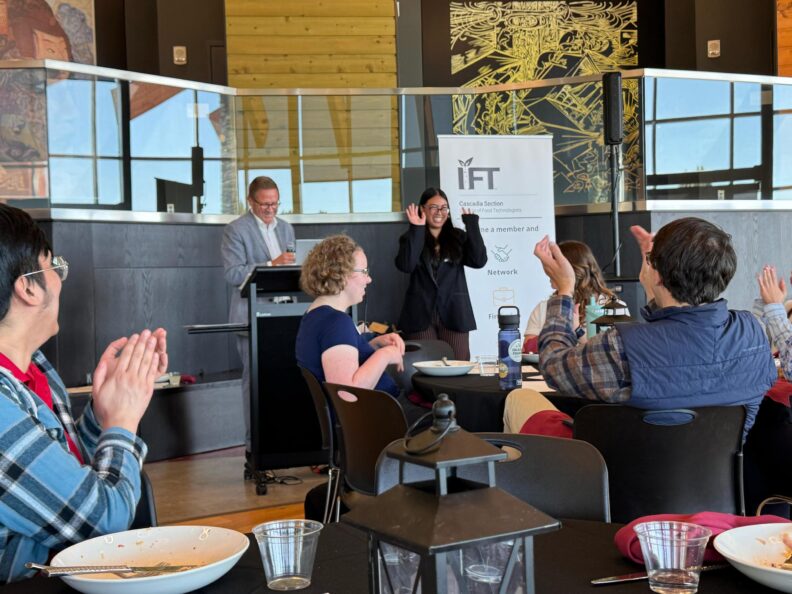
If you’re an out of state student and you think university is too expensive, because that was me when I was applying, just know that having a bachelors in food science, especially at WSU, opens you to a whole new opportunity of scholarships that you never thought existed, because that is what helped fund my senior year as well as given me opportunities to travel to a conference and an award ceremony.
Additionally, a great support system comes with the degree as well! The faculty here in the Food Science department are amazing and incredibly supportive. Mariana, our academic advisor, is such a great person to approach and depend on when you have questions, because sometimes I can’t figure things out on my own and I know I can always go to her.
Also, having a community is so helpful, as it really helps you push through these four years. As I have mentioned, within our food science department, we’re just a really tight knit group and it’s just super awesome to be in this nurturing and encouraging environment.
Looking ahead, what are you hoping to do after you graduate?
For a bachelor’s degree in food science, you learn bits and pieces of everything. However, with what I want to do, I need and want to learn more about food safety and food microbiology, which is why I know graduate school is a great pathway for me because I get to learn even more about it, which will also help prepare me for when I get into the industry.
Any parting words?
For anyone who’s looking into food science, please don’t let all the STEM parts scare you. I know it looks a little overwhelming, but when you chip at it bit by bit and paired with the support of your peers and professors, it is extremely rewarding and worth it. I think it’s also important to really find that community that you can lean on as well, no matter what major you are in. There are so many events, clubs, and groups of people around you that you can endlessly evolve to be the person who you want to be by the end of your four years.